Provisioning
What it is
Provisioning is the background work that turns "create environment" into a running database, logins, connection rules and services. It is written so that a crash at any moment never causes the same work to run twice on a guess; when the outcome is unknown, it stops and asks for an operator.
Why
Choice: record before acting, refuse when unsure. Creating an environment touches Docker, PostgreSQL and files. If the worker dies halfway, simply retrying could create a second database, reuse a half-made login, or overwrite connection rules another operation just wrote. So every external effect is preceded by a durable record, and after a crash the worker settles only what it can prove.
Rejected alternative: idempotent retry. "Just run it again, it is idempotent" assumes every step can detect its own partial result. Several cannot (a database created but not yet closed to other logins, a reload that was sent but not confirmed), and guessing wrong on a shared engine can hurt a neighbour.
How we built it
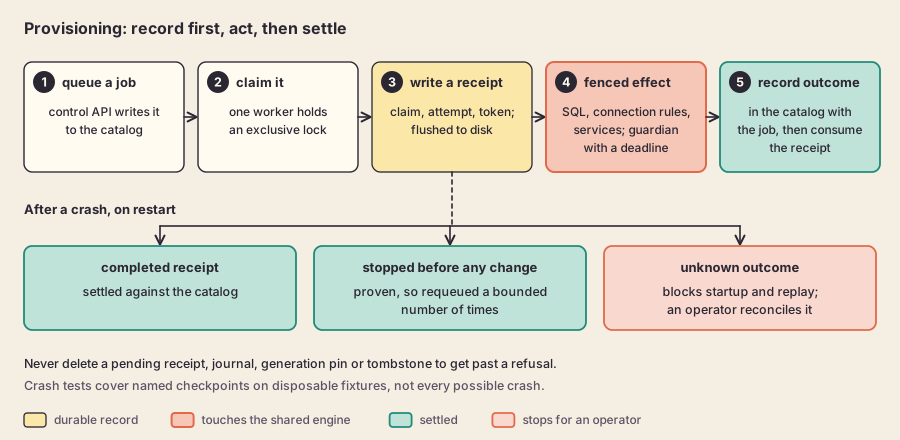
Record first, act, then settle. An unknown outcome never runs twice on a guess.
The same exchange as a sequence:
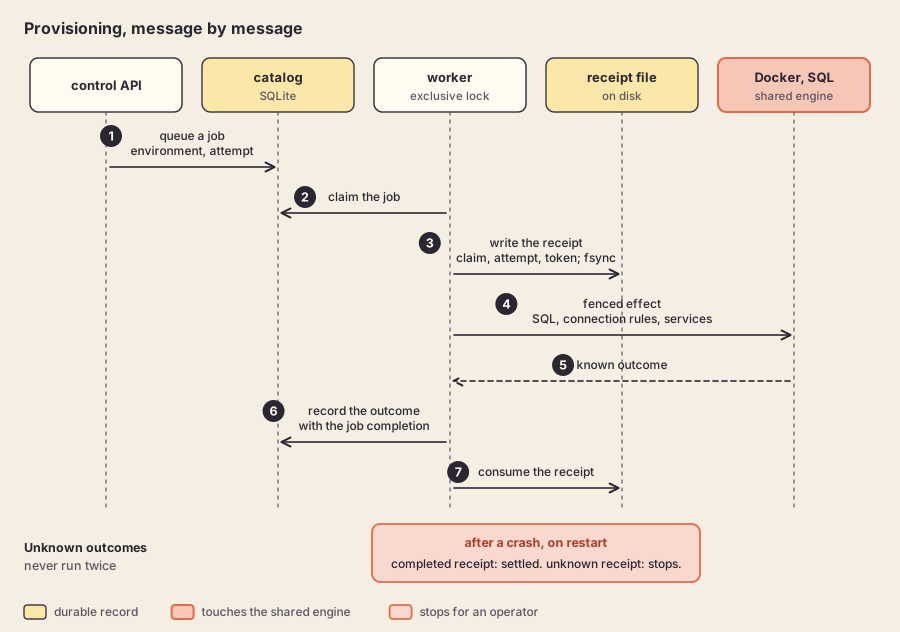
The receipt is on disk before the effect runs, and consumed only after the outcome is in the catalog.
The pieces, in plain words (each term is also in the glossary):
- Worker lock. Only one provisioning worker runs at a time; it holds an exclusive file lock.
- Effect receipt. Before an effect starts, the worker writes a small file naming the exact job claim and attempt, and flushes it to disk. It never overwrites an existing one. A completed receipt is settled against the catalog on restart; a pending one with no proof of outcome blocks startup and any replay.
- Guardian and witness. The effect runs under a guardian process with a deadline. The native provisioner writes a completion witness when it finishes, so a lost acknowledgment can be recovered without re-running the work.
- Fencing. SQL and connection-rule changes carry an operation token. Once a token is revoked (a tombstone is written), a stale process holding it cannot write again, even if it wakes up later.
- Generation pin. Each managed database container is pinned by its exact identity. Startup refuses a container that changed underneath it, and only
lab/migrate-generation.pymay replace one, through its own journaled and crash-tested steps. - Preflight recovery. An interruption proven to have happened before any external change can be requeued automatically, a bounded number of times.
Code: lab/worker.py, lab/effect_receipt.py, lab/effect_lease.py, lab/provision.py, lab/sql_operation_fence.py, lab/hba_authority.py, lab/hba_generation.py, lab/migrate-generation.py. The read-only inspector is lab/inspect-provisioning.py.
Limits
- This is replay prevention, not complete automatic recovery. A later-stage unknown outcome stays blocked until an operator reconciles it; the bounded reconciliation workflow for those cases is not built.
- Crash tests cover named checkpoints on disposable fixtures, not arbitrary crashes, Docker daemon failure or power loss.
- A killed provisioner may leave a Docker client or daemon-side effect running; the pending receipt only stops the worker from repeating it.
- Trusted operator code and direct Docker or SQL access are outside this protection.
- Never delete a pending receipt, journal, generation pin or tombstone to get past a refusal.